

If you’ve ever paused mid-sentence wondering whether to use sense vs since, you’re definitely not alone. These two words look similar, sound somewhat alike in casual speech, and often confuse English learners and even native speakers.
In this guide, we’ll break down sense vs since in a simple, practical way so you never mix them up again. We’ll look at meanings, usage, examples, and common mistakes people make when using since or sense in writing.
Sense vs Since: Quick Overview
Before going deeper, here’s the simplest way to understand the difference:
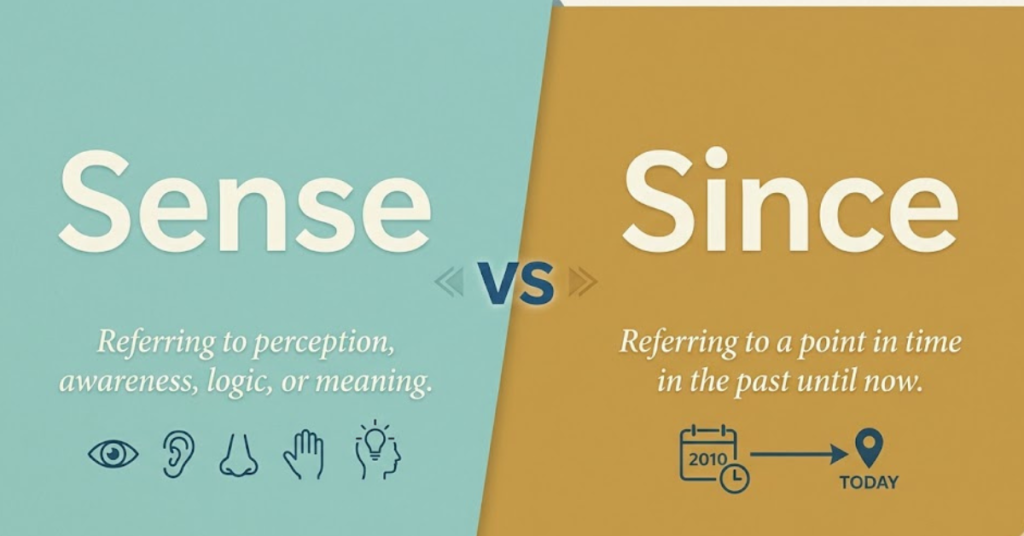
- Sense → related to meaning, feeling, or perception
- Since → related to time or cause/reason
So when comparing since vs sense, remember: they serve completely different grammatical purposes.
What Does “Sense” Mean?
The word sense is mainly used as a noun and sometimes as a verb. It relates to understanding, awareness, or physical perception.
Common meanings of “sense”:
- Meaning or understanding
- Feeling or intuition
- Physical ability (like sight or smell)
- Logical reasoning
Examples of “sense” in sentences:
- This sentence doesn’t make any sense.
- I could sense something was wrong.
- She has a strong sense of direction.
So if you’re asking “makes since or sense?” — the correct phrase is always “makes sense.”
What Does “Since” Mean?
The word since is usually used as a preposition, conjunction, or adverb. It mainly refers to time or cause.
Two main uses of “since”:
1. Time reference
Used to show when something started.
- I have lived here since 2015.
- She has been working here since Monday.
2. Reason or cause
Used to explain why something happens.
- Since it was raining, we stayed inside.
- Since you’re here, let’s start the meeting.
So when thinking about since or sense, remember: since is about time or reason, never meaning.
Sense vs Since: Key Differences
Here’s a quick comparison to make it even clearer:
| Feature | Sense | Since |
| Meaning | Understanding or feeling | Time or reason |
| Type | Noun/verb | Preposition/conjunction |
| Usage | “That makes sense” | “Since yesterday” |
| Function | Logic or perception | Time/cause relationship |
This table helps clear up the confusion between since vs sense instantly.
Common Mistakes People Make
Many learners mix these words in casual writing. Here are some common errors:
- That doesn’t make since
That doesn’t make sense - I haven’t seen you sense Monday
I haven’t seen you since Monday - Since that idea is good (when meaning understanding)
That idea makes sense
Easy Trick to Remember Sense vs Since
Here’s a simple memory hack:
- Sense = “understand” (think S for Sense = Smart thinking)
- Since = “starting point in time” (think S for Since = Start time)
Once you remember this, choosing between sense vs since becomes much easier.
Why People Get Confused Between Sense and Since
There are a few reasons this confusion happens:
- Similar spelling (only one letter difference)
- Fast spoken English makes them sound alike
- Lack of grammar context while writing
- Auto-correct mistakes in typing
But once you understand their roles, the confusion disappears quickly.
FAQs About Sense vs Since
1. Is it sense or since when meaning understanding?
It is always sense when referring to understanding or meaning.
2. What is correct: “makes since” or “makes sense”?
The correct phrase is makes sense.
3. Can “since” mean understand?
No, since never means understand. It only refers to time or reason.
4. Why do people confuse sense and since?
Because they look and sound similar, especially in fast speech.
5. What is the difference between sense and since in simple words?
- Sense = meaning or understanding
- Since = time or reason
Conclusion
Understanding sense vs since is all about recognizing their roles in a sentence. While sense deals with meaning, logic, and perception, since is used for time and reasoning.
If you ever get stuck, just pause and ask: Am I talking about understanding or time? That simple question will guide you every time.
Mastering small grammar differences like since or sense can make your writing clearer, more professional, and easier to read.