
Some words look so similar that it is easy to assume they mean the same thing. That is exactly what happens with immersion vs emersion. At first glance, the two terms seem interchangeable, but they actually describe opposite actions.
If you have ever wondered whether to use immersion or emersion, you are not alone. These words appear in science, education, medicine, and everyday writing, and knowing the difference can make your communication much clearer.
Immersion vs Emersion: The Basic Difference
The simplest way to understand immersion vs emersion is this:
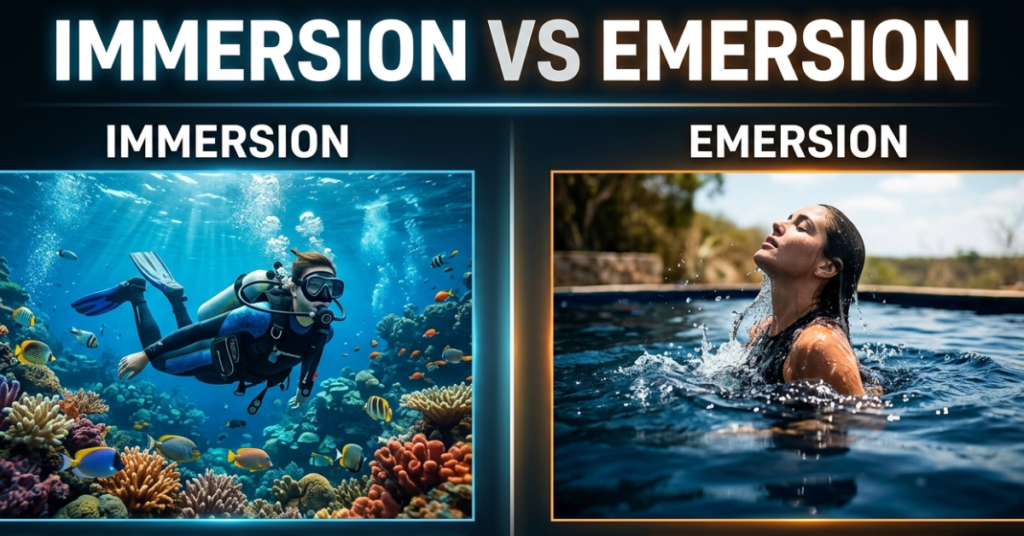
- Immersion means going into a liquid, environment, or experience.
- Emersion means coming out of a liquid, environment, or experience.
Think of them as opposite movements.
Quick example
- A diver entering the water experiences immersion.
- The same diver rising back to the surface experiences emersion.
That single contrast explains most of the confusion between emersion vs immersion.
What Does Immersion Mean?
The word immersion comes from the Latin word meaning “to dip into.”
It usually refers to being deeply involved in something physically or mentally.
Common meanings of immersion
Physical immersion
Being submerged in liquid.
- The tea bag needs full immersion in hot water.
Mental immersion
Being deeply engaged.
- The game creates total immersion for players.
Language immersion
Learning through constant exposure.
- Students improve faster in an immersion program.
What Does Emersion Mean?
Emersion means emerging from a liquid or rising above a surface.
It is less common in everyday speech but appears often in technical fields.
Common meanings of emersion
In biology
Some plants grow partly above water during emersion.
In diving
A diver returning to the surface undergoes emersion.
In geology
Land rising above water can be described as emersion.
Example:
- The turtle’s slow emersion from the pond signaled sunrise.
Immersion or Emersion in Different Fields
Different professions use these terms in specific ways.
Education
Immersion is common.
- Language immersion programs
- Virtual learning immersion
- Cultural immersion
Emersion is rarely used in education.
Marine Biology
Both terms appear.
- Immersion = underwater
- Emersion = exposed above water
For example:
A coral reef may alternate between immersion and emersion due to tides.
Virtual Reality
Immersion dominates in technology.
Users often describe:
- sensory immersion
- visual immersion
- emotional immersion
Emersion may describe the moment a user returns to real-world awareness.
Emersion vs Immersion: Side-by-Side Comparison
| Term | Meaning | Direction |
| Immersion | Going into something | Inward |
| Emersion | Coming out of something | Outward |
This simple comparison helps distinguish emersion or immersion quickly.
Why People Confuse These Words
There are several reasons people mix up emmersion vs immersion:
Similar spelling
Only one letter changes.
Similar pronunciation
They sound close in conversation.
Rare usage of emersion
Most people see “immersion” more often.
Because emersion is less common, many assume it is just a misspelling.
How to Remember the Difference
A quick memory trick can help.
Think of the prefixes:
- Im- = in
- E- = exit
So:
- Immersion = in
- Emersion = out
That small trick makes the difference easier to recall.
Examples in Everyday Sentences
Here are examples of immersion vs emersion in context.
Immersion examples
- The spa offers full-body water immersion.
- The novel creates emotional immersion.
- Children learn quickly through language immersion.
Emersion examples
- The whale’s emersion thrilled the tourists.
- Plant roots survive repeated emersion.
- The diver’s emersion was carefully monitored.
When to Use Immersion or Emersion
Use immersion when describing:
- entering water
- deep involvement
- full engagement
- sensory experience
Use emersion when describing:
- rising from water
- becoming exposed
- reappearing
- surfacing
That distinction keeps your writing accurate.
FAQs
What is the difference between immersion vs emersion?
Immersion means going into something, while emersion means coming out of it.
Is emersion a real word?
Yes, emersion is a correct English word, though it is less commonly used than immersion.
Which is more common: immersion or emersion?
Immersion is much more common in everyday English.
Is emersion the opposite of immersion?
Yes, in many contexts, emersion is considered the opposite of immersion.
Can immersion be used metaphorically?
Yes. People often use immersion to describe deep mental or emotional involvement.
Conclusion
Understanding immersion vs emersion becomes simple once you see the direction of movement involved. Immersion means going inward or becoming deeply involved, while emersion means emerging outward or returning to the surface.
Whether you are writing about science, education, technology, or daily life, choosing the correct word makes your meaning sharper and more professional. The next time you debate immersion or emersion, remember one easy rule: immersion goes in, emersion comes out.