
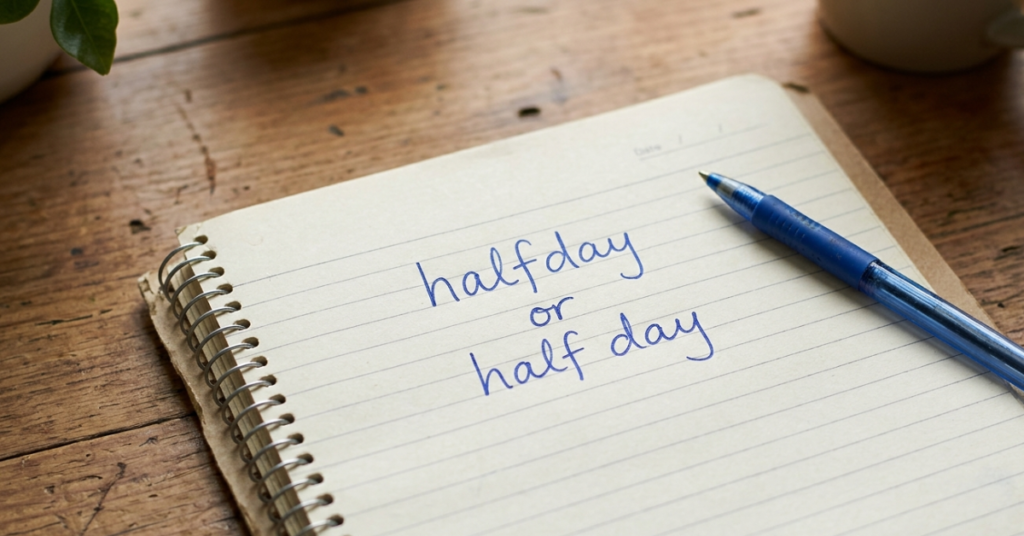

English has a way of turning simple words into confusing ones, and halfday or half day is a perfect example. You may have seen it written as one word, two words, or even with a hyphen, leaving many people unsure which version is actually correct.
The short answer is that context matters. Depending on how the word is used in a sentence, half day, half-day, and sometimes even halfday can appear—but only one form is considered standard in most modern writing. Let’s break it down clearly so you can use it with confidence.
Halfday or Half Day: The Correct Form
The most widely accepted standard spelling is:
half day
Written as two separate words, this form is used when referring to a period that lasts for half of a normal day.
Example:
- I am taking a half day off work tomorrow.
- The school scheduled a half day before the holiday.
In most professional and academic writing, half day is the preferred form.
Half Day or Half-Day?
The question of half day or half-day depends on grammar.
Use half day as a noun
When the phrase acts as a thing.
Examples:
- We worked only a half day.
- Friday is a half day for students.
Use half-day as an adjective
When it describes another noun.
Examples:
- She attended a half-day meeting.
- They booked a half-day tour.
Simple rule:
- Noun → half day
- Adjective → half-day
Is “Halfday” One Word?
The single-word form halfday occasionally appears online, but it is not considered standard in formal English.
Example:
I requested a halfday from work.
Better:
I requested a half day from work.
Most dictionaries and style guides favor:
- half day
- half-day
So if you are writing professionally, it is best to avoid halfday.
Halfday Meaning vs Half Day Meaning
The halfday meaning and half day meaning are essentially the same:
A period lasting approximately half of a normal day.
This can refer to:
- work schedules
- school hours
- tours
- events
- medical leave
Common examples:
- Morning only
- Afternoon only
- Four-hour shift
- Reduced schedule
The phrase simply means less than a full day.
Why the Hyphen Matters
Understanding half-day or half day becomes easier when you remember what hyphens do.
A hyphen joins words together to describe another noun.
Compare these:
- half day leave
- half-day leave request
Both may be understood, but the second is grammatically cleaner because the phrase describes “leave request.”
Example:
- He signed up for a half-day workshop.
The hyphen improves readability.
Common Situations Where “Half Day” Is Used
You will often see this phrase in everyday life.
Workplace
Employees may request:
- a half day off
- a half-day shift
- a half-day absence
School
Schools may schedule:
- half days before holidays
- parent conference half days
- shortened classes
Travel
Tour companies may offer:
- half-day excursions
- half-day city tours
The meaning stays consistent across contexts.
Half Day in Professional Writing
In business writing, the safest choice is:
Correct professional usage:
- half day when standing alone
- half-day before another noun
Examples:
I need a half day tomorrow.
I need a half-day appointment tomorrow.
This keeps your writing polished and clear.
Common Mistakes to Avoid
Here are mistakes people often make.
Incorrect:
I am taking a halfday.
Better:
I am taking a half day.
Incorrect:
We booked a half day trip.
Better:
We booked a half-day trip.
The hyphen often makes sentences easier to read.
Quick Memory Trick
A simple way to remember:
If it stands alone:
Use half day
If it describes something:
Use half-day
Example:
- I worked a half day.
- I worked a half-day shift.
That one rule solves most confusion.
FAQs
Is halfday or half day correct?
Half day is the standard correct spelling in most writing.
Should half-day have a hyphen?
Yes, when it acts as an adjective before a noun.
What does half day mean?
It means a period that lasts for half of a regular day.
Is halfday one word?
It appears occasionally, but it is not the preferred standard form.
Which is correct: half day or half-day?
Both can be correct depending on grammar:
- half day = noun
- half-day = adjective
Conclusion
The confusion around halfday or half day comes from the fact that English often changes spelling based on usage. In most cases, half day is the correct standard form, while half-day works when the phrase describes another noun.
The easiest way to remember it is simple: use half day by itself, and use half-day before another word. Once you know that rule, this common grammar question becomes much easier to handle in everyday writing.