
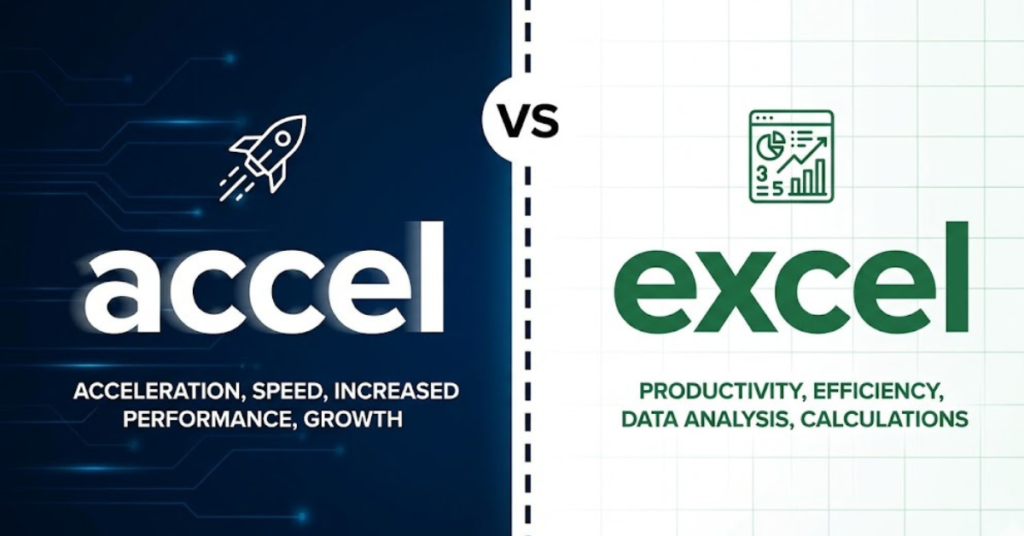

If you’ve ever come across accel vs excel and wondered whether they mean the same thing, you’re not alone. These two words look similar, but they come from very different roots and are used in completely different contexts. In this guide, we’ll break down excel vs accel, explain what does accel mean, and help you avoid common confusion in everyday writing and conversation.
Accel vs Excel: Quick Overview
At a glance, these two words are often confused because they sound similar—but their meanings are not related.
- Accel → Short form of “accelerate” (to speed up or increase pace)
- Excel → To be outstanding or perform exceptionally well
Accel vs Excel: Comparison Table
Here’s a simple breakdown to make things clearer:
| Feature | Accel | Excel |
| Full meaning | Accelerate (short form) | To perform extremely well |
| Word type | Informal abbreviation / tech usage | Verb (standard English) |
| Meaning | Speeding up or increasing rate | Being excellent or superior |
| Usage | Engineering, tech, gaming contexts | Academic, professional, daily language |
| Formal English | Not standard word | Correct and widely used |
What Does “Accel” Mean?
Let’s start with accel.
Meaning:
“Accel” is commonly used as a shortened form of accelerate, meaning to increase speed or move faster.
Common Usage Areas:
- Engineering
- Automotive industry
- Gaming or software
- Informal tech writing
Example:
- “The car begins to accel after 60 km/h.”
- “The system will accel processing speed under load.”
Important note: Accel is not a formal dictionary word in standard English, but it is widely used in technical and informal contexts.
What Does “Excel” Mean?
Now let’s look at excel, the correct standard English word.
Meaning:
To excel means to be outstanding, superior, or very good at something.
Example Sentences:
- “She excels in mathematics.”
- “The company excels in customer service.”
Key Idea:
Excel = being the best or performing extremely well
Excel vs Accel: Key Differences Explained
Let’s compare them clearly:
1. Meaning Difference
- Accel → Speed increase
- Excel → High performance or excellence
2. Usage Context
- Accel → Technical or informal usage
- Excel → Academic, professional, everyday English
3. Grammar Category
- Accel → Abbreviation/slang
- Excel → Proper verb
Accels vs Excels: Plural Usage Confusion
Sometimes people search for accels vs excels, but here’s the clarification:
- Accels → Rare, informal, not standard
- Excels → Correct third-person verb form
Example:
- Correct: “He excels in sports.”
- Incorrect: “He accels in sports.”
Common Mistakes People Make
Here are frequent errors:
- Confusing “accel” with “excel”
- Using “accel” in formal writing
- Assuming both mean “to do well”
- Misspelling “excel” as “accel”
Easy Way to Remember the Difference
Try this simple trick:
Accel = Accelerate = Speed
Excel = Excellence = Success
If it’s about speed → accel
If it’s about quality → excel
When Should You Use Each Word?
Use “Accel” when:
- Talking about speed or acceleration
- Writing informal or technical notes
- Working in engineering or software contexts
Use “Excel” when:
- Writing essays or reports
- Talking about performance
- Describing success or achievement
FAQs About Accel vs Excel
1. Is “accel” a real word?
It is not a standard dictionary word but is used as a shorthand for “accelerate.”
2. What does “excel” mean?
It means to be outstanding or very good at something.
3. Which is correct: accel or excel?
Both are used in different contexts, but excel is the correct formal English word.
4. Can I use “accel” in writing?
Only in informal, technical, or shorthand contexts—not in formal writing.
5. Why do people confuse accel and excel?
Because they sound similar and are only one letter apart.
Conclusion
When comparing accel vs excel, the difference is actually quite simple. Accel relates to speed and is mostly used informally or in technical fields, while excel is the correct English word meaning to perform exceptionally well.
Understanding this difference helps you write more clearly and avoid common mistakes, especially in professional or academic settings. If you remember “speed vs success,” you’ll never confuse them again.