
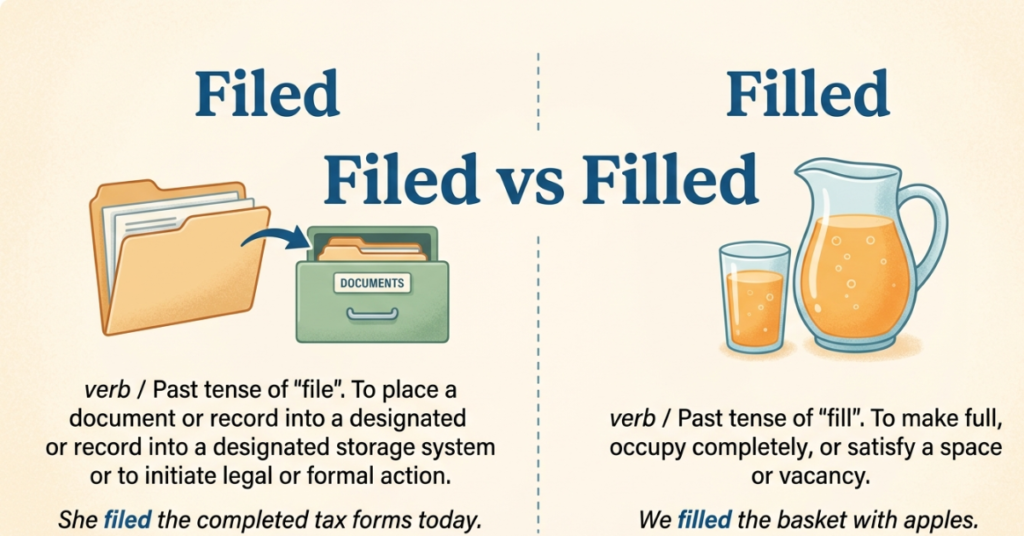

Ever typed a sentence and stopped at “filed or filled”, unsure which one fits? You’re not alone. The confusion between filed vs filled is incredibly common because the words sound similar—but their meanings are completely different.
In this guide, we’ll break down the filed vs filled difference in simple terms, with clear examples so you can use each word confidently in everyday writing.
Filed vs Filled Meaning: The Quick Answer
Let’s start with a simple distinction:
- Filed = Related to documents, records, or submitting something
- Filled = Means something is made full or occupied
Even though they sound alike, they belong to entirely different contexts.
What Does “Filed” Mean?
The word filed is the past tense of file. It’s commonly used in formal, legal, or organizational settings.
Filed Meaning:
- To submit official documents
- To organize papers in a system
- To smooth or shape something using a tool (less common usage)
Examples:
- “She filed the tax return yesterday.”
- “The lawyer filed a complaint in court.”
- “He filed the documents in the cabinet.”
Where You’ll See “Filed” Most:
- Legal documents
- Office work
- Government forms
What Does “Filled” Mean?
The word filled comes from fill, meaning to make something full or occupied.
Filled Meaning:
- To put something into a space until it’s full
- To occupy time, space, or emotion
Examples:
- “The glass is filled with water.”
- “The room was filled with laughter.”
- “She filled out the form completely.”
Notice how “filled” often relates to quantity, space, or emotion.
Filed vs Filled: Key Differences
Here’s a quick side-by-side comparison:
| Word | Meaning | Example |
| Filed | Submitted or organized documents | “He filed the report.” |
| Filled | Made something full | “She filled the bottle.” |
Easy Way to Remember:
- Filed = Paperwork / Records
- Filled = Full / Content inside something
Common Mistakes with Filed or Filled
Mixing up filed or filled can completely change the meaning of your sentence.
Incorrect:
- “She filled a complaint.”
- “He filed the glass with water.”
Correct:
- “She filed a complaint.”
- “He filled the glass with water.”
One small spelling mistake can lead to a totally different meaning.
Filed vs Filled in Everyday Sentences
Let’s look at real-life examples to make things clearer:
Using “Filed”:
- “The company filed for bankruptcy.”
- “I filed all my receipts last night.”
Using “Filled”:
- “The stadium was filled with fans.”
- “She filled the application form online.”
Synonyms for Filled
If you want to improve your vocabulary, here are some filled synonym options:
Common Synonyms:
- Packed
- Loaded
- Stuffed
- Occupied
- Brimming
Example:
- “The hall was packed with people.” (instead of filled)
When to Use Filed or Filled
Here’s a simple rule to follow:
Use “Filed” When:
- You’re talking about documents
- You mean submitting or organizing
- The context is formal or legal
Use “Filled” When:
- You’re talking about space or quantity
- Something is being made full
- The context is physical or emotional
Quick Grammar Tip
If you’re unsure which one to use, ask yourself:
“Am I talking about paperwork or making something full?”
- Paperwork → Filed
- Full → Filled
FAQs
1. What is the difference between filed and filled?
“Filed” refers to submitting or organizing documents, while “filled” means making something full.
2. Is it filed or filled a complaint?
People use the correct phrase “filed a complaint.”
3. What does filed mean?
Filed means to submit, record, or organize documents officially.
4. What does filled mean?
Filled means something has been made full or occupied.
5. Can filed and filled be used interchangeably?
No, they have completely different meanings and cannot be used interchangeably.
Conclusion
Understanding filed vs filled is easier than it seems once you know the core difference. Filed is all about documents and formal actions, while filled is about making something full—whether it’s a glass, a room, or even an emotion.