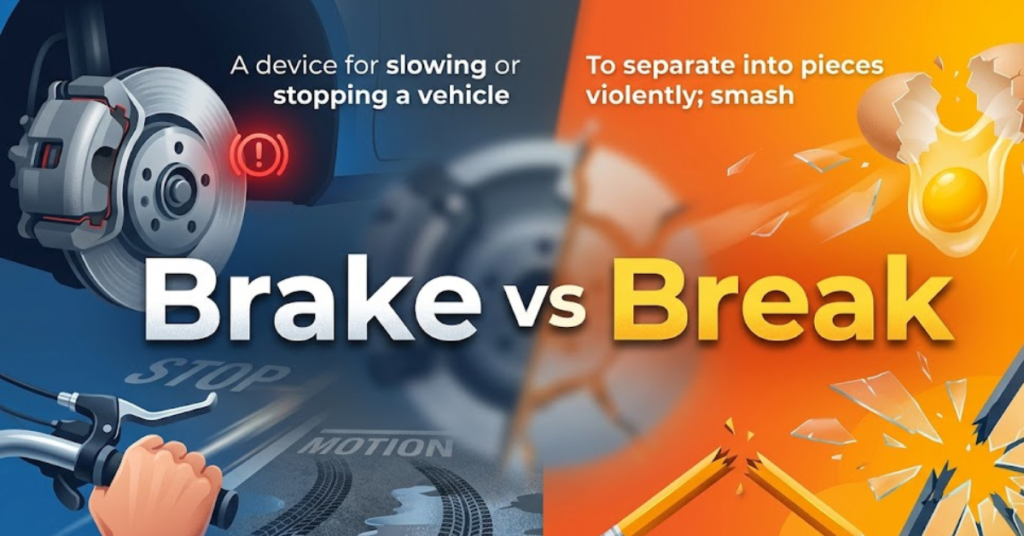

Ever typed a sentence and paused, wondering whether to use brake or break? You’re not alone. The confusion between brake vs break is incredibly common because they sound identical—but their meanings couldn’t be more different.
In this guide, we’ll break down (pun intended!) the differences, show you how to use each correctly, and give you simple tricks to remember them forever.
Why Do People Confuse Brake vs Break?
The mix-up happens because both words are homophones—they sound the same but have different meanings and spellings.
Here’s the quick truth:
- Brake → Related to stopping (usually vehicles)
- Break → Means to separate, damage, pause, or interrupt
Once you connect each word to its purpose, the confusion becomes much easier to manage.
What Does “Brake” Mean?
Definition of Brake
Brake is a noun and verb related to slowing down or stopping motion, especially in vehicles.
Examples of Brake in a Sentence
- Press the brake gently when approaching a turn.
- The car’s brakes need servicing.
- He had to brake suddenly to avoid an accident.
Easy Memory Trick
Think of brake = stop.
Both words are associated with control and slowing down.
What Does “Break” Mean?
Definition of Break
Break is a much more flexible word. It can mean:
- To separate into pieces
- To damage something
- To pause or interrupt
- To escape or end something
Examples of Break in a Sentence
- Be careful not to break the glass.
- Let’s take a short break.
- He finally broke the bad habit.
Brake vs Break: Key Differences
Here’s a simple comparison to make things crystal clear:
| Word | Meaning | Usage Example |
| Brake | To stop or slow down | Apply the brake while driving |
| Break | To damage or pause | Take a break from work |
Breaked or Broke: What’s Correct?
A common follow-up question in the brake vs break debate is:
Is it “breaked” or “broke”?
The correct past tense of break is broke, not breaked.
Correct:
- He broke the window.
Incorrect:
- He breaked the window.
Other Forms of Break
- Present: break
- Past: broke
- Past participle: broken
How Do You Spell Break Correctly?
If you’re ever unsure how to spell break, remember:
“Break” contains “ea”, like in eat
Think: You take a break to eat
This little trick helps lock in the correct spelling.
Common Mistakes with Brake vs Break
Let’s look at a few everyday errors and fixes:
- I need to break the car.
I need to brake the car. - Let’s take a brake.
Let’s take a break. - The driver hit the break.
The driver hit the brake.
When to Use Brake vs Break (Quick Guide)
Use this simple checklist:
Use “Brake” when:
- Talking about vehicles
- Slowing or stopping motion
- Mechanical systems
Using “Break” when:
- Something is damaged
- You need a pause
- Something ends or separates
FAQs About Brake vs Break
1. What is the main difference between brake and break?
Brake refers to stopping motion, while break means to separate, damage, or pause.
2. Is it “brake vs break” or “break vs brake”?
Both phrases are used, but brake vs break is more common when comparing meanings.
3. How do you remember brake vs break?
- Brake = Stop (car-related)
- Break = Damage or pause
4. Is “breaked or broke” correct?
The correct form is broke. “Breaked” is not grammatically correct.
5. Can “break” be used as a noun and verb?
Yes!
- Verb: Don’t break the plate.
- Noun: Take a break.
Conclusion
Understanding brake vs break doesn’t have to be confusing. Once you connect brake with stopping and break with damage or pauses, everything falls into place.
To recap:
- Brake → Stop or slow down
- Break → Damage, separate, or pause
- Broke → Correct past tense of break
Mastering these small differences can instantly improve your writing and communication. If you found this helpful, try exploring other commonly confused words—you’ll be surprised how quickly your grammar sharpens.