
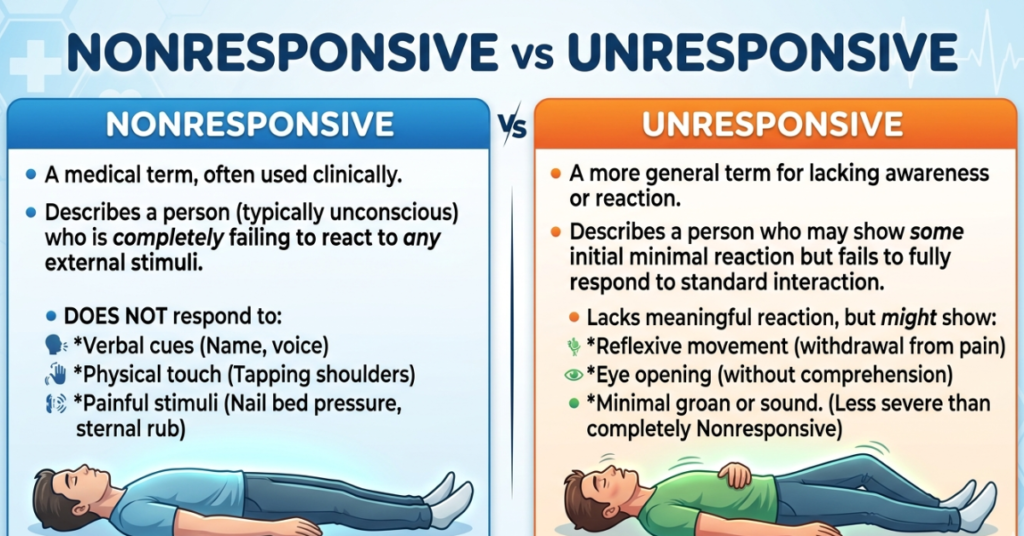

At first glance, nonresponsive vs unresponsive may seem like a small language detail, but choosing the right word can make your writing clearer and more professional. These two terms often appear in healthcare, technology, business communication, and everyday conversation, yet many people are unsure whether they mean the same thing.
If you have ever wondered about unresponsive vs nonresponsive, you’re not alone. Both words can describe a lack of reaction, but their usage can depend on context, tone, and industry standards. Understanding the distinction can help you communicate more accurately.
Nonresponsive vs Unresponsive: The Short Answer
Both words can be correct, but they are used differently.
Quick breakdown:
- Unresponsive → more common in everyday English
- Nonresponsive → often used in technical or medical settings
Example:
- The patient became unresponsive after surgery.
- The treatment was nonresponsive to previous medications.
So when comparing non responsive vs unresponsive, the better choice depends on what you are describing.
What Does Unresponsive Mean?
The word unresponsive usually means someone or something fails to react.
Common meanings of unresponsive:
- Not replying
- Not reacting physically
- Ignoring communication
- Frozen or inactive technology
Examples:
- My phone became unresponsive after the update.
- The child was tired and seemed unresponsive.
- He remained unresponsive to repeated emails.
In most casual writing, unresponsive sounds more natural.
What Does Nonresponsive Mean?
The term nonresponsive also means a lack of response, but it often sounds more formal or clinical.
Common uses:
- Medical reports
- Scientific writing
- Business analysis
- Technical documentation
Examples:
- The tumor was nonresponsive to treatment.
- The market remained nonresponsive to policy changes.
- The system was nonresponsive during testing.
In professional writing, nonresponsive can feel more precise.
Non Responsive or Unresponsive: Which Is Better?
Many writers ask whether to use non responsive or unresponsive.
In most cases:
Unresponsive = better for general writing
Nonresponsive = better for technical contexts
Example in daily language:
Better:
- My laptop is unresponsive
Less natural:
- My laptop is nonresponsive
Example in technical language:
Better:
- The patient was nonresponsive to medication
In this case, the technical tone works well.
Unresponsive vs Nonresponsive in Medical Settings
In healthcare, word choice matters.
Unresponsive
Often describes:
- unconscious patients
- lack of physical reaction
- emergency situations
Example:
- The patient was found unresponsive.
Nonresponsive
Often describes:
- failed treatments
- lack of improvement
- diagnostic outcomes
Example:
- The infection was nonresponsive to antibiotics.
This is why unresponsive vs nonresponsive matters more in professional fields.
Grammar: Is Nonresponsive One Word?
A common question is whether it should be written as:
- non responsive
- non-responsive
- nonresponsive
Modern preferred spelling:
nonresponsive
Most style guides prefer the closed form as one word.
Examples:
- nonresponsive patient
- nonresponsive software
- nonresponsive audience
So when comparing non responsive vs unresponsive, the correct form is usually one word.
Everyday Examples of Both Words
Here are side-by-side examples.
Unresponsive
- My screen became unresponsive.
- She seemed emotionally unresponsive.
- The customer was unresponsive to messages.
Nonresponsive
- The device remained nonresponsive after rebooting.
- The cancer was nonresponsive to chemotherapy.
- The market stayed nonresponsive to the announcement.
When to Use Each Word
Here is a simple way to choose.
Use unresponsive when talking about:
- people
- phones
- computers
- communication
- everyday situations
Use nonresponsive when discussing:
- medical reports
- scientific writing
- treatment outcomes
- technical systems
This makes the unresponsive or nonresponsive decision much easier.
Why the Difference Matters
Using the right word can improve:
- clarity
- professionalism
- credibility
- reader trust
For example:
Less precise:
- The medication was unresponsive.
Better:
- The medication was nonresponsive.
The second sentence sounds more accurate because medications themselves do not respond; conditions respond to them.
Common Mistakes to Avoid
Writers often make these mistakes.
Avoid:
The customer was nonresponsive in casual chat
The customer was unresponsive
The patient was unresponsive to chemotherapy
The patient was nonresponsive to chemotherapy
Context makes the difference.
FAQs
Is nonresponsive the same as unresponsive?
They are similar, but unresponsive is more common in everyday English, while nonresponsive often appears in technical or medical writing.
Which sounds more natural in daily writing?
Unresponsive usually sounds more natural in regular conversation.
Is non responsive one word?
Yes, modern usage prefers nonresponsive as one word.
Can I use unresponsive in medical writing?
Yes, especially when describing a person who is unconscious or not reacting.
Which is better for SEO writing?
Use both naturally if your audience searches for nonresponsive vs unresponsive, but prioritize readability first.
Conclusion
When comparing nonresponsive vs unresponsive, both words can be correct, but they are not always interchangeable. Unresponsive works best in everyday language, while nonresponsive often fits medical, technical, or formal writing more naturally.
The key is understanding context. If you know what you are describing, choosing between unresponsive or nonresponsive becomes much easier. Paying attention to these subtle language differences can make your writing clearer, stronger, and more professional.
If you enjoy learning about commonly confused words, exploring similar grammar guides can sharpen your writing even more.