
If you’ve ever paused mid-sentence wondering about dysregulation vs disregulation, you’re not alone. These words look similar, sound almost identical, and often show up in psychology, health, and everyday writing—making them easy to mix up.
In this guide, we’ll break down dysregulation vs disregulation, explain which one is correct, and show you how to use the right term confidently. By the end, you’ll not only know the difference but also understand the meaning behind each word.
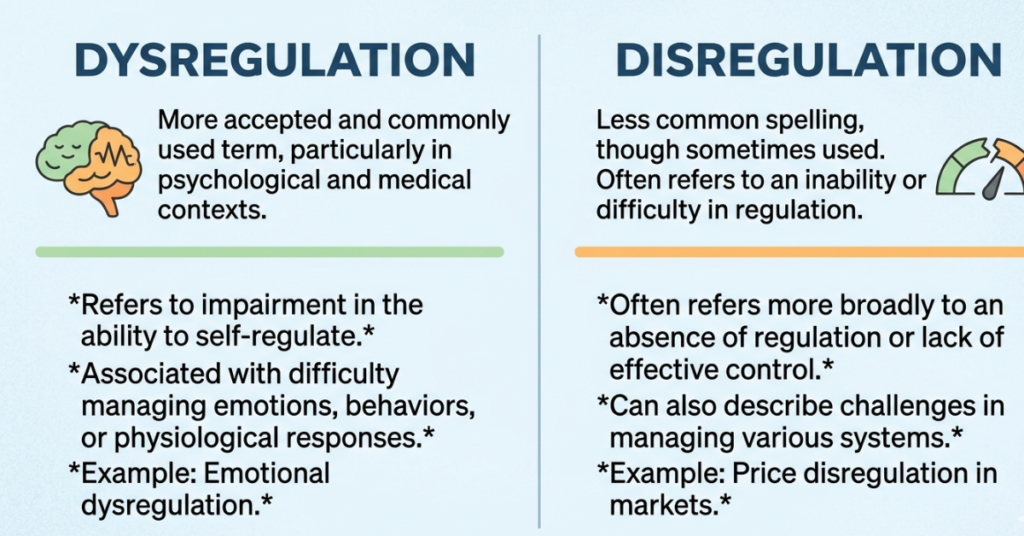
Dysregulation vs Disregulation: The Correct Spelling
Let’s clear up the confusion right away:
- Dysregulation → Correct and widely used
- Disregulation → Incorrect or extremely rare in standard English
So when comparing dysregulation vs disregulation, the correct term is dysregulation.
What Does “Dysregulation” Mean?
Definition of Dysregulation
Dysregulation refers to difficulty in managing or controlling a system, process, or emotional response.
It’s commonly used in:
- Psychology
- Medicine
- Neuroscience
Examples:
- “Emotional dysregulation can affect relationships.”
- “Hormonal dysregulation may cause health issues.”
Why “Disregulation” Is Incorrect
The confusion in dysregulation vs disregulation often comes from mixing up prefixes.
Key difference in prefixes:
- Dys- → Means impaired, abnormal, or difficult
- Dis- → Means not or opposite of
While “disregulation” might seem logical, it’s not recognized as a standard term in most dictionaries. The correct prefix for this concept is dys-, not dis-.
Dysregulated vs Disregulated: Which One Is Right?
Another common variation is dysregulated vs disregulated.
Correct forms:
- Dysregulated → Proper adjective
- Disregulated / Disregulated → Incorrect or nonstandard
Example:
- “He felt emotionally dysregulated after the stressful event.”
- “He felt emotionally disregulated…”
Dysregulated or Unregulated: Are They the Same?
This is where things get interesting.
Dysregulated vs Unregulated:
- Dysregulated → Something is functioning improperly
- Unregulated → Something lacks control or rules entirely
Simple breakdown:
- Dysregulated = not working correctly
- Unregulated = not controlled at all
Example:
- “A dysregulated system produces errors.”
- “An unregulated market has no restrictions.”
Where Is Dysregulation Commonly Used?
Understanding context helps you use the word correctly.
1. Emotional Dysregulation
Difficulty managing emotions like anger, anxiety, or sadness.
2. Biological Dysregulation
Imbalance in body systems (e.g., hormones or immune response).
3. Behavioral Dysregulation
Impulsive or uncontrolled actions.
Synonyms and Related Terms (LSI Keywords)
To expand your understanding, here are related words:
- Imbalance
- Dysfunction
- Instability
- Irregularity
- Emotional instability
- Poor regulation
These terms can sometimes replace or support dysregulation depending on context.
Common Mistakes to Avoid
When dealing with dysregulation vs disregulation, keep these tips in mind:
- Don’t swap dys- with dis-
- Avoid using “disregulated” in formal writing
- Double-check spelling in academic or professional contexts
If you’re unsure, stick with dysregulation—it’s the correct and accepted term.
Easy Memory Trick
Here’s a simple way to remember:
- Dysregulation = Dysfunction (both start with “dys”)
- Disregulation = Doesn’t exist (in this context)
This quick association makes it easier to avoid mistakes.
Why Getting It Right Matters
Using the correct term in dysregulation vs disregulation is more than just spelling—it affects clarity.
It helps you:
- Communicate accurately in health and psychology topics
- Avoid confusion in academic writing
- Sound more credible and professional
FAQs
1. Is “disregulation” a real word?
No, it’s not commonly recognized in standard English usage.
2. What does dysregulation mean?
It refers to difficulty in controlling or managing processes, emotions, or systems.
3. Which is correct: dysregulated or disregulated?
“Dysregulated” is correct.
4. Is dysregulated the same as unregulated?
No. Dysregulated means functioning improperly, while unregulated means lacking control entirely.
5. Where is dysregulation used most?
It’s commonly used in psychology, medicine, and behavioral sciences.
Conclusion
When comparing dysregulation vs disregulation, the answer is clear: dysregulation is the correct and widely accepted term. The confusion usually comes from similar prefixes, but once you understand the meaning of “dys-,” it becomes much easier to remember.